
Thai Train Seat vs Sleeper: How to Choose for Your Trip
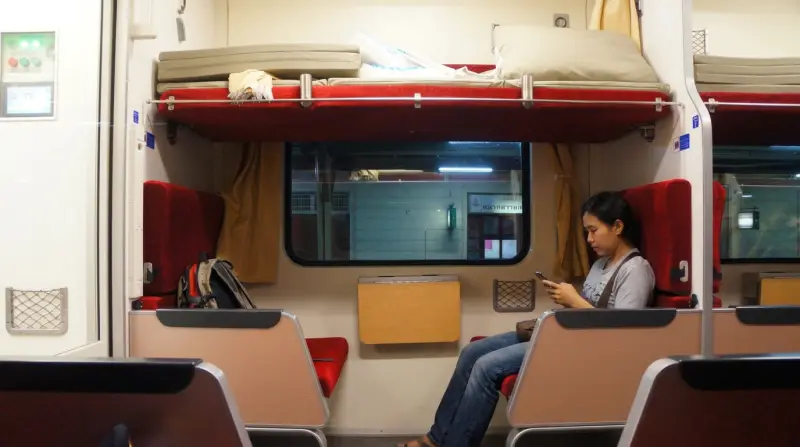
A seat can be practical for a daytime trip when you expect to stay awake. A sleeper gives you a bed for an overnight journey. The better choice depends on your ability to rest seated, your arrival plans, accessibility and the options actually available. There is no single journey length that makes a sleeper essential for everyone.
Start with the time you will spend aboard
Look at departure and arrival times as well as total duration. A shorter trip that crosses your normal sleeping hours may be harder in a seat than a longer daytime journey. Conversely, a daylight service can suit travellers who want to watch the scenery and sleep in a hotel that night.
For Bangkok–Chiang Mai, the Thai government’s route guide distinguishes second-class AC seating on trains 7/8 from sleepers on services 9/10 and 13/14. These are different choices, not simply different prices for the same experience. See the route overview and check the current timetable for your date.
When a seat makes sense
Consider a seat for a local excursion, a daytime journey, or a trip where the savings matter more than lying down. Check whether the seat is reserved and whether the carriage has AC or fans. Second class does not automatically mean the same seat design on every train.
A basic third-class carriage may suit a short journey for travellers comfortable with shared seating and warm conditions. For a longer daytime ride, compare the available second-class option. Avoid assuming that a service label such as Express guarantees AC in every carriage.
When a sleeper is worth considering
A sleeper is useful when you need a bed overnight or want to reduce time spent sitting. Second-class sleepers offer curtained berths in a shared carriage. First-class sleepers commonly use two-berth compartments; a single berth does not automatically buy exclusive use. Our first-class versus second-class comparison covers privacy and occupancy.
Check upper and lower berth access. Lower berths generally have more width and a window; upper berths require climbing. If a traveller has restricted mobility, discuss the actual layout and boarding arrangements before purchase. Do not assume that a bed, a lower berth or a first-class ticket resolves every access need.
| Your priority | Option to compare | Check before paying |
|---|---|---|
| Daytime sightseeing journey | Reserved seat | Travel time, cooling and reservation status |
| A bed overnight | Second-class sleeper | Berth type, access and shared-carriage layout |
| Private sleeping space | First-class compartment | Occupancy and exclusive-use availability |
| Lowest workable cost | Available seated classes | Comfort for the whole trip, not fare alone |
Compare the total trip cost and arrival plan
An overnight train may replace a hotel night, but an early arrival does not guarantee hotel check-in. Budget for luggage storage, meals or an early room if needed. Allow time for delays before separate buses, ferries or flights. A train ticket alone does not promise a protected onward connection.
Food, sockets, showers and toilets vary by service. Carry essential medication, water and charging backup as appropriate. Follow the published luggage guidance; a sleeper booking does not remove baggage limits or guarantee space for oversized items.
Book the accommodation you have chosen
Use official SRT D-Ticket or your selected booking channel to check the applicable sales window and current options. Review the full station names, class, berth or seat, total price and ticket instructions. ThailandTrain.org is an independent booking service. Search your route and date, and use the train-class overview to interpret the accommodation labels.
Adapted from: MNXANL · CC BY-SA 4.0 — Illustration adapted from a reference photograph.